
Home Builder Pricing Explained: Why Bids Aren't Guarantees and How to Plan for Unknowns
Most homeowners assume a builder’s bid is a fixed number, but in reality it’s only a price based on what can be known at the time. As construction unfolds, unknowns and design details come into focus, and costs shift accordingly. Understanding how pricing models work is the key to avoiding surprise and building with confidence.
Most homeowners enter a build believing that a builder's "bid" is the final word on price. It feels intuitive: the builder gives a number, the homeowner accepts it, and both parties expect the project to land at that number.
In residential construction, though, a bid is not a guarantee. It's a snapshot of cost based on what can be known today. Because construction involves hundreds of assumptions, discoveries, and evolving details, costs shift regardless of how the builder structures their pricing.
Understanding why this happens is the foundation for clearer expectations, healthier relationships, and better decision-making. This article breaks down the primary pricing models, the common sources of cost changes, and the role contingencies play in protecting the budget.
Why Pricing Models Confuse Homeowners
From the outside, builder pricing seems simple: you get a bid, you compare the numbers, you pick the builder.
But each builder uses a different combination of estimating methods, pricing structures, and assumptions. Two builders can price the same home with a 20–30% spread, not because one is wrong, but because they're making different assumptions about what the project will require.
The biggest misunderstanding is this: no pricing model eliminates unknowns. It only changes how unknowns are handled.
Whether a project is fixed-price, cost-plus, or somewhere in between, discoveries can and do affect cost.
The Three Pricing Models Homeowners Are Most Likely to See
Fixed Price (Lump Sum)
This is the model homeowners feel most comfortable with because it seems certain. A fixed price means the builder agrees to deliver the work described in the plans for a predetermined cost.
Homeowners assume: "This number won't change."
What it actually means: "This number won't change if everything in the plans is complete and accurate and field conditions match assumptions."
I've seen this play out dozens of times. A builder bids a project assuming typical soil conditions. During excavation, the equipment hits solid rock. Removing it requires additional machinery, labor, and time. Because the builder priced ordinary excavation, not rock removal, the cost changes even under a fixed-price contract, unless the contract explicitly included that condition.
Fixed price is not a guarantee against discovery. It's a price for a defined scope based on known information.
Cost-Plus
Cost-plus passes the actual cost of the work to the homeowner, with an agreed-upon markup for the builder's overhead and profit.
Homeowners often think: "If I can see all the costs, I won't have surprises."
Transparency helps, but unknown conditions still increase cost. You just see it line by line.
Here's an example: after pricing, the structural engineer updates beam sizes based on final load calculations. Larger beams require additional steel and installation labor. Under cost-plus, the homeowner pays the difference. The pricing model didn't cause the change. The discovery did.
Builders with strong estimating discipline use allowances and contingencies to buffer these changes. Builders without those systems place more risk on the homeowner.
Hybrid or Allowance-Driven Models
Many residential builders use a mix of fixed amounts and allowances. This model often looks like a fixed price on paper but contains numerous variable components.
Homeowners often interpret the total as a guaranteed number, when in reality:
Allowances act as placeholders
The final cost depends on actual selections and market pricing
Unknown conditions still flow through as changes
Because allowances can vary widely builder-to-builder, they can create a false sense of comparison during bidding.
The Two Types of Cost Changes Homeowners Encounter
Not every cost change comes from a mistake or a builder error. In fact, most fall into one of these predictable categories.
Unknown or Unforeseen Conditions
These are discoveries made once work begins. Common examples include rock or unsuitable soil, underground water, code-required changes after permitting, structural revisions after engineering, and items missing from the original design documents.
These impact cost under every pricing model because the original bid could not incorporate something that wasn't known.
As an architect, I can tell you that this happens even with good documentation. A builder bids a home based on preliminary plans. When construction documents are finalized, additional details emerge: more beams, more insulation, more finishes. The bid reflected what was shown at the time. The cost changes reflect the final scope.
This is one reason commercial construction treats incomplete drawings as a high-risk condition and budgets accordingly.
Homeowner-Driven Changes
These are discretionary adjustments initiated by the homeowner: upgraded finishes, added square footage, changing window packages, or modifying layout or design intent.
These are expected throughout the design and build process and are typically handled through change orders. This article focuses less on those, but distinguishing them helps clarify that unknowns and homeowner choices are different drivers of cost movement.
Why Contingency Budgets Are Not Optional
Contingency is a professional planning tool, not "padding" or hidden margin.
There are two types worth acknowledging:
Construction Contingency covers field conditions and discoveries: rock, soil, drainage, utility conflicts, structural adjustments, and similar unknowns.
Design Contingency covers the natural evolution of details as design progresses. The earlier in the design process a project is priced, the more design contingency is recommended.
Both exist because a builder can only price what is documented and known. Projects evolve. Conditions reveal themselves. Contingency absorbs that reality.
Without contingency, cost overruns become disputes, not because someone did something wrong, but because the budget wasn't prepared for the known unknowns of construction.
Why Pricing Models Don't Determine Success (Fit Does)
It's easy to believe certain pricing models are inherently safer: "Fixed price means no surprises." "Cost-plus means more transparency." "Allowances protect the budget."
But pricing models don't guarantee outcomes. They simply allocate risk differently.
What actually matters:
How complete the design documents are
How disciplined the builder's estimating process is
How the builder has historically managed unknowns
How transparently the builder communicates changes
How well the pricing model fits the builder's operational systems
This is why two builders with the same pricing model can deliver completely different experiences.
The right pricing model is the one the builder can execute consistently and the homeowner understands clearly.
What Homeowners Should Know
You don't need to become an expert in construction accounting. But you do need a clear understanding of how pricing works.
A bid is based on what can be known today, not a guarantee. Unknown conditions affect every pricing model. Expanded scopes and design evolution change costs in predictable ways. Contingencies are a professional buffer, not overcharging. Allowances look fixed but are inherently variable. And builder fit matters more than the pricing structure itself.
The more you understand these realities, the more productive your conversations with builders become, and the more aligned the entire project feels from the start.

Beyond the Bid: 5 Hard Questions You Must Ask Your Custom Builder
The most important work happens before the first shovel hits the ground.
Building a custom home in East Idaho isn't a transaction; it’s a marriage. You are going to be legally and financially tied to this person for the next 12 to 18 months.
Most homeowners start the interview process by looking at photos of finished homes. They say, "I love that kitchen!" or "Look at that trim work!"
But looking at a portfolio only tells you that they can finish. It doesn't tell you how painful the process was to get there.
As an architect-led team, when we sit down to vet a builder for our clients, we don't just look at the pretty pictures. We look under the hood. Here are 5 "Hard Questions" we ask—and that you should too.
1. "Who will actually be on my job site every day?"
The Trap: You meet the owner of the building company. They are charismatic, organized, and confident. You sign the contract because you trust them.
The Reality: Once the contract is signed, you might never see the owner again. You get handed off to a Project Manager (PM) or a Site Superintendent. If that PM is inexperienced or disorganized, your project will suffer, no matter how great the owner is.
The Fix: We ask to meet the specific Superintendent assigned to your project before you sign. We want to know their workload. Are they managing 10 other homes in Rexburg, or just yours and one other in Jackson?
2. "How do you handle 'The Bad News'?"
Construction is imperfect. Materials get delayed. Subcontractors get sick. Winter hits early.
I always ask builders: "Tell me about the last project that went off the rails. How did you handle it?"
If they say, "Oh, we never have major issues," run. They are lying.
I want to hear: "We had a lumber delay, so I called the client immediately, presented three options, and we adjusted the schedule together." We are looking for transparency, not perfection.
3. "Are you financially solvent enough to handle a draw delay?"
This is an uncomfortable question, but it is vital.
In custom construction, bank draws (payments from your loan) can sometimes take weeks to process. If a builder is living "paycheck to paycheck," a delayed draw might mean they can't pay their plumber. If the plumber doesn't get paid, he walks off the job, and your house sits empty for three weeks.
We vet builders for financial stability. We want to know that they have the cash flow to keep materials moving even if the bank paperwork is slow.
4. "What software do you use to track my money?"
It is 2025. If a builder is tracking your $1.5M budget on the back of a napkin or a messy Excel spreadsheet, that is a red flag.
We prefer builders who use professional management software like Buildertrend or CoConstruct.
These platforms allow you to:
See the schedule in real-time.
Approve Change Orders digitally (no "he said/she said").
See exactly where every dollar is going.
If they aren't using modern tools, they are likely wasting time—and time is money.
5. "Can I speak to your current clients?"
Every builder has a list of "Raving Fans"—past clients from three years ago who love them.
I want to talk to the client whose house is currently being framed.
Are they happy right now?
Is the site clean?
Did the builder show up yesterday?
The current client is in the messy middle of the "marriage." Their feedback is the most honest data point you will get.
The "Expert" Difference
You can ask these questions yourself. But here is the secret: Builders answer differently when an Architect is in the room.
When we ask about "Scope Gaps" or "Financial Solvency," they know they can't bluff. They know we speak their language.
If you want an expert on your side of the table to ask the hard questions, that’s what we do.
[Start Your Match]
Why Builder Fit Predicts Project Success More Than Price
The lowest number is almost never the safest bet. You wouldn't hire someone for your company based on their hourly rate alone. You'd want to know how they work and how they communicate. Why would you choose a builder any differently?
A few years ago, I watched a commercial project go sideways. Four bids. Three within 2% of each other. One dramatically lower.
The owner chose the low bid.
Eighteen months later, they were in court—and the final cost matched the original three bids anyway.
Nothing illegal happened. It wasn't fraud. It wasn't even incompetence. It was a mismatch. The builder's operating system didn't align with the project's needs or the owner's expectations.
In residential construction, the stakes are even higher because most projects start with less definition. The less complete your plans are, the more essential the right builder becomes.
Why Most People Start With Price (And Why That Backfires)
Most people start by comparing bids. That makes sense—numbers feel objective. You can line them up in a spreadsheet and feel like you're making a logical decision.
But the lowest number is almost never the safest bet.
You wouldn't hire someone for your company based on their hourly rate alone. You'd want to know how they work, how they communicate, whether they've done this kind of work before, and whether their process matches your expectations.
Why would you choose a builder any differently?
What Builder Fit Actually Means
Fit isn't about personality. It's not about whether you'd grab a beer with someone. It's about alignment of systems.
A right-fit builder is someone whose:
Communication style matches how you need to receive information
Process matches your project's complexity
Estimating philosophy matches your tolerance for ambiguity
Timeline expectations match reality
Quality standards align with what you're trying to build
Track record shows consistency, not just one-off successes
This is why we verify data from past and current clients—including confirming that homeowners actually built with the builder. Stories matter, but validated experiences reveal patterns. And patterns predict future performance.
How Builders Operate Differently
The residential market hasn't historically offered a structured way to match homeowners with builders. You get a few referrals, a handful of websites, and a stack of estimates that are impossible to compare apples-to-apples.
But builders operate very differently from one another:
Their communication cadence. Some send weekly updates. Others go radio silent for three weeks and assume no news is good news.
Their estimating philosophy. Some pad every line item. Others estimate tight and expect you to understand contingencies.
Their scheduling systems. Some manage two projects at a time. Others juggle ten and hope nothing overlaps.
Their approach to quality. Some see themselves as craftsmen. Others see themselves as project coordinators who hire craftsmen.
Their tolerance for ambiguity. Some can work from sketches. Others need complete drawings before they'll price anything.
When these elements line up with your expectations, projects feel steady. When they don't, friction fills every gap.
What Right-Fit Actually Looks Like in Practice
When alignment is strong, homeowners aren't surprised when the framer needs an extra week. They're not blindsided by what site prep actually costs. They have a realistic picture before the contract is signed.
They trust the builder's judgment. They don't feel like passengers—they feel like partners. They experience fewer surprises and less emotional volatility.
Contrast that with choosing based on the lowest bid:
Every change or delay feels personal. Mismatched expectations show up as frustration, confusion, or distrust. The highs are high until the lows hit—and then the lows are brutal.
Fit doesn't eliminate every challenge. Construction is messy by nature. But it reduces volatility, which is ultimately what homeowners value most.
Borrowing From Commercial Construction
Commercial construction figured this out decades ago. Projects commonly use two structured processes:
RFQ (Request for Qualifications): Are you the right builder for this project?
RFP (Request for Proposal): How do you propose to deliver this project?
Both are followed by interviews with the top candidates, allowing decision-makers to evaluate alignment before selecting a partner.
Residential construction rarely uses this level of rigor—but homeowners need it even more. A commercial developer building an office park has done this before. A homeowner building a custom house is doing it for the first (and probably only) time.
Builder Selection's mission is to bring that discipline, structure, and transparency to the residential market so homeowners don't have to rely on guesswork or price alone.
The Bottom Line
Right-fit builders reduce risk. They improve communication. They deliver more predictable outcomes. They create a steadier, more enjoyable experience.
And ultimately, they help homeowners build with confidence, not hope.
Here's what we're trying to fix: Right now, homeowners are forced to make a $500K+ decision based on three PDFs and a gut feeling. That's insane. We're building the system that should have existed all along.
By shifting the question from "Who is the lowest price?" to "Who is the right fit for my project?", homeowners protect both their investment and their experience.
The True Cost of Building a Custom Home in East Idaho (And Why Bids Are Misleading)
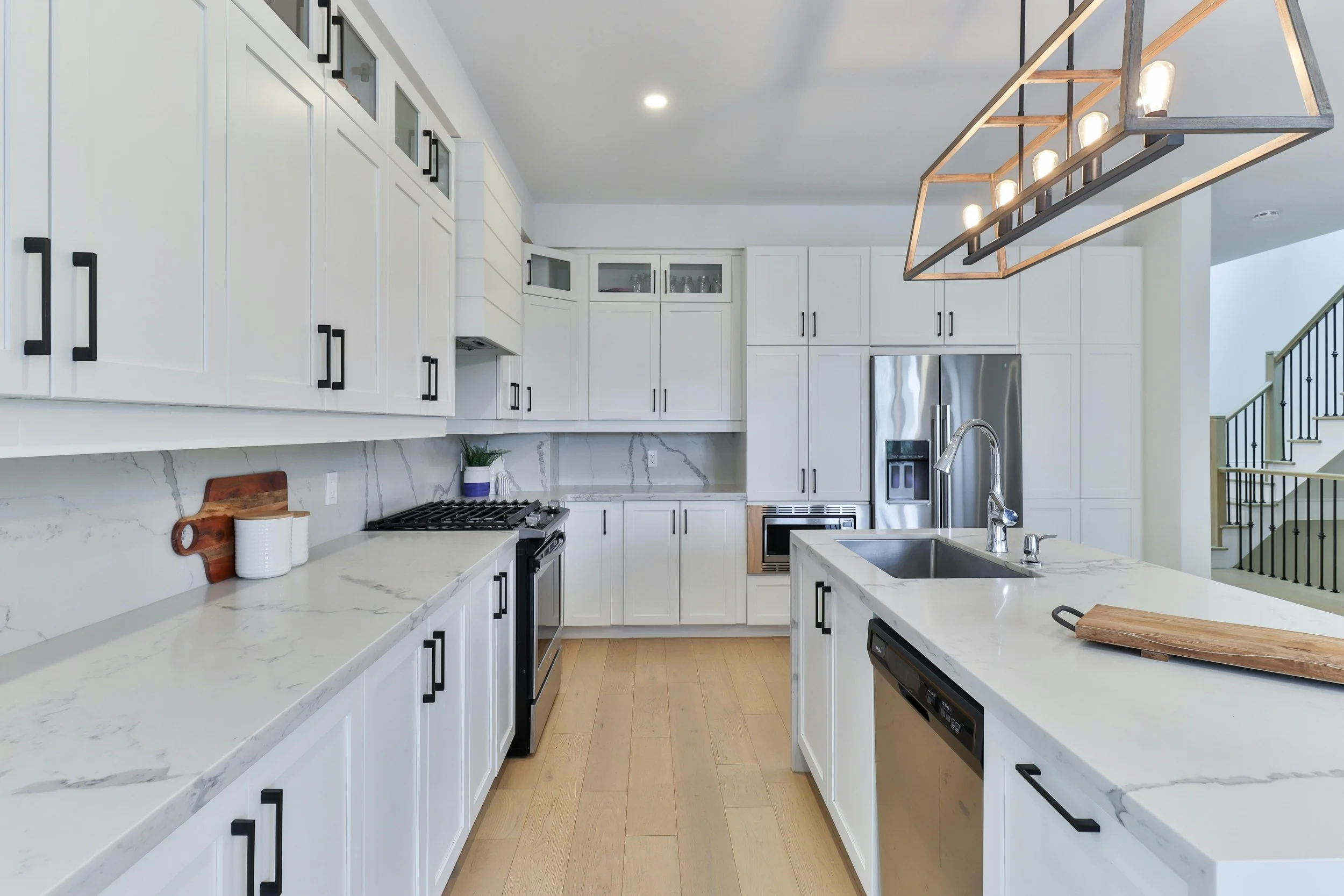
Modern kitchen cabinets in East Idaho custom home
One of the most common questions we get in our industry is simple: "How much is this going to cost?"
As we consider that, it’s actually a pretty broad question. When you look at the different finishes somebody might have in their home, or even the specific site location—it can make a huge difference in the final price.
Because of those variables, it’s a really difficult question to answer. It’s not one that we can just throw out a number for and feel really good about. I think you’ll see that a lot with builders, too, where they might give you a huge range that their "typical" home costs.
But here is where it gets dangerous for you as a buyer. Due to this issue we have within the industry, many times a builder will just set an "Allowance" for certain things to get the bid done. And that is where the trouble starts.
The Allowance Trap: A $40,000 Example
Let's look at a real-world example. You might have one builder give you a $20,000 allowance for cabinets. It looks great on paper because it keeps the total bid low.
But another builder, bidding on the exact same project, might look at your design and bid $60,000 for cabinets because they know what you actually want.
So now you have this $40,000 gap. Builder A is proposing one thing, and Builder B is proposing something else. If you go with the lower bid, you are going to get stuck with a massive change order later to cover that difference. (Or, in the rare case you come in under budget, you’re going to have a little bit of money left at the end—which I don't think anybody would complain about—but that rarely happens with low allowances).
The "Scope Gap" (Apples to Apples)
Beyond just allowances, there is a massive issue we call the Scope Gap. These are the "little things" that get left out of a bid but cost a fortune to fix later.
For example:
The Driveway: One builder includes a paved driveway. Another is just planning on gravel and then they’re going to walk away.
The Landscaping: One might have full landscape included, while another has zero.
You’ve got to try to nail down what the true scope is so that you can get an apples-to-apples comparison.
This isn't always possible for a homeowner to do on their own because there aren't always plans that exist that are fully vetted and show that entire scope you're requesting. So we have to make sure that is really getting covered—that the builder or builders you're interviewing are covering all of that.
This is why we exist: to force builders to bid on the exact same scope, which protects our buyers from surprises.
Why You Need an Advocate (Not Just a Realtor)
One of the differences that exists with what we’re doing is understanding who plays what role in your project:
Realtors help you buy the land.
Architects and drafters help you design the house.
But ultimately, you're going to spend a lot of money with a contractor. Selecting that contractor really becomes a pivotal moment. You might spend quite a bit of money with a realtor to select the land, but that pales in comparison to the construction contract.
Some architects will help you select a builder, but it's generally not their focus.
That’s really where my background comes in. I focus on helping owners select the right builder. We do that through a grading process and an interview process that comes from the commercial side of construction. We are bringing that professional rigor into the residential side to help owners feel good about the decision they're making.
We want to truly vet that builder out so that you don't become one of those horror stories that people might have heard about.